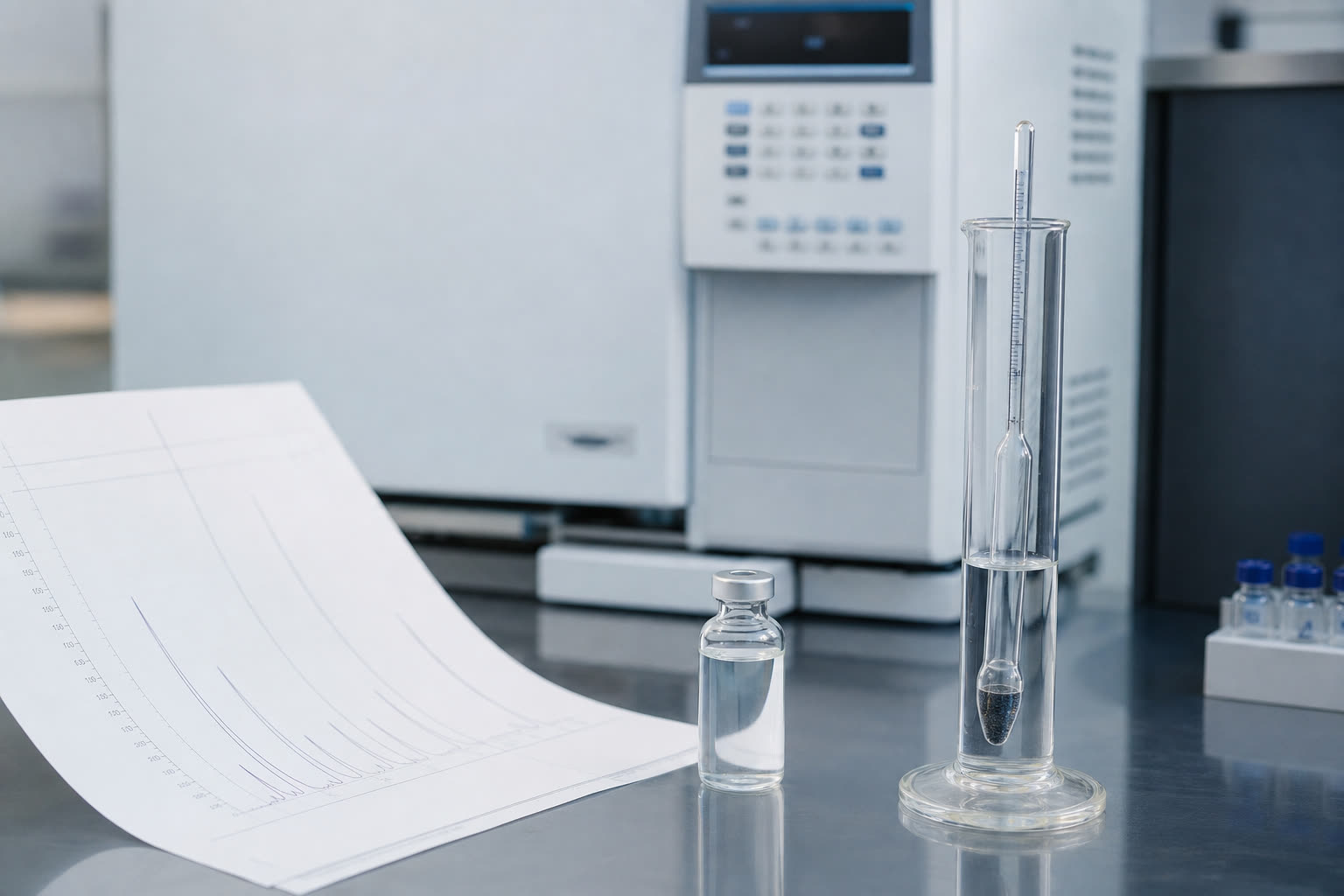
A buyer can verify a turpentine sample with five bench tests: gas chromatography for terpene composition, specific gravity, refractive index, evaporation residue and colour. Together they take a competent lab less than a day, and they expose almost every quality problem, from adulteration with mineral solvent to oxidised stock. Here is how to run and read each one.
Why test at all if a COA is supplied?
A certificate of analysis states what the supplier found on the lot. Your own testing confirms the drum you received matches it, protects you in any dispute, and builds the baseline you will use for every future consignment. We send samples before bulk orders precisely so buyers can do this on double distilled turpentine oil and gum turpentine oil before money moves.
What does the GC assay tell you?
Gas chromatography is the decisive test. It separates the sample into its terpene components and reports each as an area percentage. On a DD turpentine trace you should expect alpha-pinene in the 70 to 80 percent band, with beta-pinene, delta-3-carene, camphene and limonene making up most of the rest. Standard GTO runs 60 to 70 percent alpha-pinene. Read the whole fingerprint, not just the headline number, because the minor peaks tell you the pine species and reveal blending. A cluster of non terpene peaks is the classic signature of cutting with petroleum solvent. Background on why the headline number matters is in alpha-pinene content explained.
Practical GC pointers
- Use a non polar or slightly polar capillary column commonly applied for essential oils.
- Run a certified alpha-pinene reference alongside the sample to anchor retention times.
- Compare traces lot to lot. Drift in minor peaks flags a change in resin source before it becomes a production problem.
How do you run specific gravity, and what is a pass?
Fill a calibrated pycnometer or use a digital density meter at 25 degrees Celsius. Genuine gum turpentine sits between 0.855 and 0.870. The test is cheap and brutal to adulterants: mineral turpentine and kerosene cuts typically pull density below the band, while heavy residues push it above. A sample outside the range fails before you even reach the GC. The contrast with petroleum solvents is laid out in turpentine vs mineral turpentine.
What does refractive index confirm?
Refractive index on an Abbe refractometer at 25 degrees Celsius should read 1.465 to 1.480 for gum turpentine. It takes two minutes and one drop of sample. RI and specific gravity together form a tight cross check: it is difficult to blend a cheap diluent into turpentine and keep both constants inside their bands at the same time. Log both values for every drum you sample.
Why measure evaporation residue?
Weigh a few grams into a tared dish, evaporate on a steam bath, dry briefly and reweigh. Good turpentine leaves only a trace of residue. High residue means dissolved rosin or heavy ends carried over from a poorly run still, and it shows up in service as sticky films, slow drying paint and fouled reaction vessels. This is one of the clearest ways a second distillation proves its worth, since the extra fractionation strips heavy material, as described in how turpentine is distilled.
How should you judge colour and appearance?
Pour the sample into a clear glass tube against daylight. Fresh turpentine is water white to very pale straw and completely clear. Haze suggests moisture, visible particles suggest dirty drums, and a distinct yellow tone in a supposedly DD grade suggests age, oxidation or poor storage. Colour alone never certifies quality, but a colour shift between the approved sample and the delivered drum is a legitimate reason to hold the lot and retest.
What does each result mean in one table?
| Test | Typical DD result | Failure usually means |
|---|---|---|
| GC alpha-pinene | 70 to 80 percent | Wrong grade, blending, or different resin source |
| Specific gravity at 25 C | 0.855 to 0.870 | Adulteration with petroleum solvent |
| Refractive index at 25 C | 1.465 to 1.480 | Dilution or off specification material |
| Evaporation residue | Trace only | Rosin carryover, heavy ends, old stock |
| Colour and clarity | Water white, clear | Oxidation, moisture, dirty packing |
What can go wrong between sampling and testing?
Turpentine oxidises on air contact, so a badly handled sample can fail tests the parent drum would pass. Draw samples into clean, dry, filled to the top glass or lined metal containers, cap immediately, keep them cool and dark, and test promptly. The same chemistry governs warehouse practice, covered in turpentine storage and safety.
Which optional tests add value for specific buyers?
Beyond the core five, three additional checks earn their bench time for particular applications.
- Distillation range. Charge a standard distillation flask and record the initial boiling point and the volume recovered below about 170 degrees Celsius. Genuine turpentine begins boiling near 150 degrees and delivers the bulk of its volume within a narrow band. A long tail into higher temperatures points to heavy ends or added high boiling solvent.
- Acidity. Titrate a weighed sample against dilute alkali. Fresh turpentine is nearly neutral, and a rising acid number is an early warning of oxidation, often visible before colour shifts. Synthesis buyers watch this closely because acidic, peroxidised feed misbehaves over catalysts.
- Moisture. A Karl Fischer titration or even a simple clarity check at low temperature protects reaction chemistry and prevents haze in wax and polish formulations.
Should you keep reference standards?
Yes. A small stock of certified reference material makes every GC run more defensible. Laboratories qualifying turpentine regularly keep alpha-pinene 95 as the anchor standard, and those tracking the carene peak add delta-3-carene so the second major peak of Indian material is positively identified rather than assumed. Retain a sealed portion of every approved sample as well, because a physical retention sample settles delivery disputes faster than any argument.
How does this fit a purchase workflow?
- Request a pre shipment sample and the supplier COA.
- Run the five tests and file the GC trace as your reference fingerprint.
- Approve in writing against those numbers.
- On delivery, spot test drums per your sampling plan and compare with the reference.
Every consignment we ship carries a certificate of analysis covering these parameters, and we welcome buyers who retest independently. Ask for a DD turpentine sample, put it through your lab, then book 200 litre barrels or a full tanker on +91 96965 09933 or info@shadeshinepine.com.