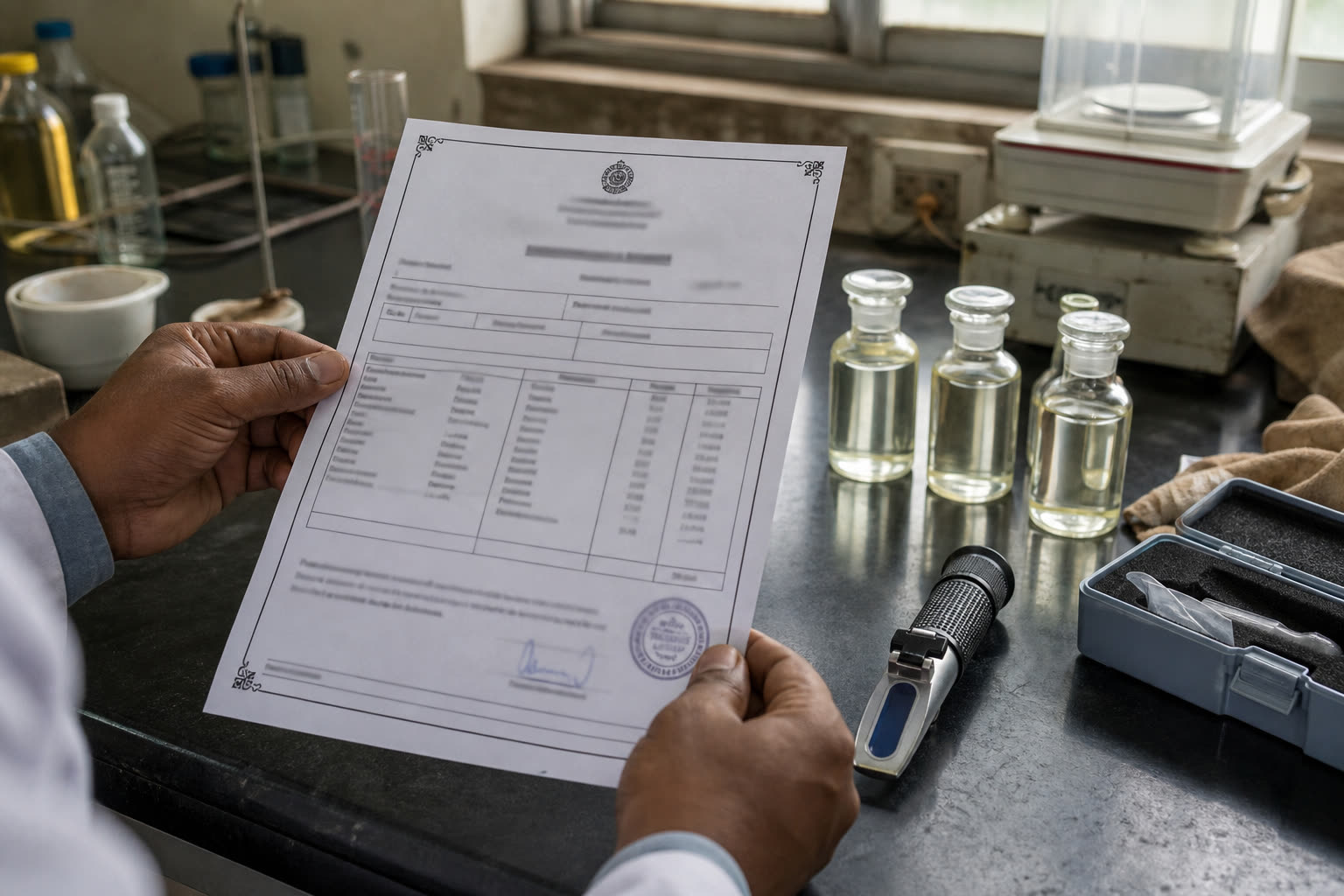
A Certificate of Analysis, or COA, is the technical summary of a specific production batch. It tells you what was actually measured on the lot that will be shipped to you, not just what the product is supposed to be in general. Reading it correctly is one of the most useful skills a chemical buyer can have. After 46 years of producing pine chemicals at our works in Kanpur, we have issued thousands of COAs, and we know which lines buyers focus on, which ones they sometimes overlook, and what the numbers actually mean in practice.
This guide uses turpentine as the primary example, with notes on rosin and pine oil where the parameters differ. See also our post on testing double-distilled turpentine for a deeper dive into DD-specific parameters.
Header information: who, what, when
Before any test result, the COA header tells you the essential identity of the batch. Check that it carries: the supplier's name and address; the product name (chemical name, not just brand name); the batch or lot number; the production date; and the test date. For turpentine in particular, a gap of several weeks between production and testing date is unusual and worth querying. Fresh batch, fresh tests, is the standard. The batch number on the COA must match the batch number stencilled or labelled on the drums you receive. If they do not match, stop and ask why.
GC purity and component composition
For turpentine products, gas chromatography (GC) analysis breaks the product down into its constituent terpene components. The key figure is alpha-pinene content, which is the dominant component of most Indian gum turpentine and the active ingredient that most buyers are actually paying for. Standard gum turpentine (GTO) from Indian oleoresin typically shows 65 to 80% alpha-pinene, with beta-pinene, camphene, limonene, and other terpenes making up the balance. Double-distilled turpentine oil (DDTO) will show a narrower, purer profile with higher alpha-pinene.
For dipentene (which is primarily limonene), the GC analysis confirms the limonene content. For terpineol, the alpha-terpineol purity is the key figure. For pine oil, the COA will show total terpineol content (as alpha, beta, and gamma-terpineol combined) as the key quality marker. Read the specification range for the grade you ordered and verify that the COA figure falls within it.
Specific gravity
Specific gravity (SG) is measured at a reference temperature, typically 25 degrees Celsius or 15.5 degrees Celsius depending on the method used. For turpentine, SG typically runs around 0.855 to 0.875. For pine oil, it is typically in the 0.930 to 0.945 range depending on grade and terpineol content. SG that falls outside the expected range for a product can indicate adulteration, incorrect distillation cut, or contamination. It is a quick screening parameter and an easy cross-check. If the SG is wrong, something else on the COA deserves closer scrutiny.
Refractive index
Refractive index (RI) is measured at 20 or 25 degrees Celsius and reported as a dimensionless number (e.g., 1.4700 to 1.4780 for turpentine). Like specific gravity, it is a fast physical check that is hard to fake without distorting other parameters. A high-quality turpentine or terpineol will have a refractive index that sits consistently within a narrow band for the grade. If you are buying the same grade repeatedly, you will notice that the RI across batches is quite consistent from a well-run plant. Sudden variation should prompt a question.
Colour
For liquid products like turpentine and pine oil, colour is typically reported on the Hazen or APHA scale (also called the platinum-cobalt scale), where lower numbers indicate a lighter, more water-white product. A fresh, well-distilled gum turpentine typically reads below 50 Hazen. Products stored for long periods or distilled from aged oleoresin may colour up. For rosin, colour is reported on the US rosin grading system (WW, WG, X, N, M, K grades from palest to darkest), or using the Gardner colour scale for some industrial rosin grades. The COA for gum rosin should clearly state the colour grade and the test method.
Residue on evaporation
This parameter tells you what is left behind when the liquid product is fully evaporated. For turpentine, a low residue figure (typically less than 0.05% or 500 mg/kg) confirms that the distillation was clean and that no heavy, non-volatile fraction was carried over into the cut. High residue suggests either that the distillation was too aggressive (pulling heavier components) or that the product has been blended with a heavier petroleum or rosin-based material. This is the adulterant-detection parameter. Take it seriously.
Flash point
The flash point is both a safety parameter and a quality indicator. For turpentine (UN 1299, Class 3, PG III), the flash point should be above 35 degrees Celsius (closed cup, typically measured by Abel or Pensky-Martens method). A product with a flash point below the Class 3 threshold for PG III would require reclassification and different packing group documentation. If your COA shows a flash point significantly different from what you expect for the grade, flag it with your freight forwarder and your safety team before handling.
Retention samples and what to do if you disagree
A responsible supplier retains a sealed sample from every batch for a defined period after shipment, typically three to six months. This retention sample is the reference point if any quality dispute arises after delivery. When you receive the goods, you should take your own sealed sample from at least two or three drums in the shipment, label them with the batch number and date, and store them appropriately. If your test results on arrival differ from the COA, the retention sample is what allows both parties to investigate fairly. We keep our retention samples as standard practice and make them available for third-party testing in the event of a genuine dispute.
If you would like to see a sample COA for any of our products before placing an order, or if you want to discuss specific test parameters for your application, write to info@shadeshinepine.com or call Yash Agarwal on +91 96965 09933. We are happy to walk through the specification sheet with you before you commit to a purchase.