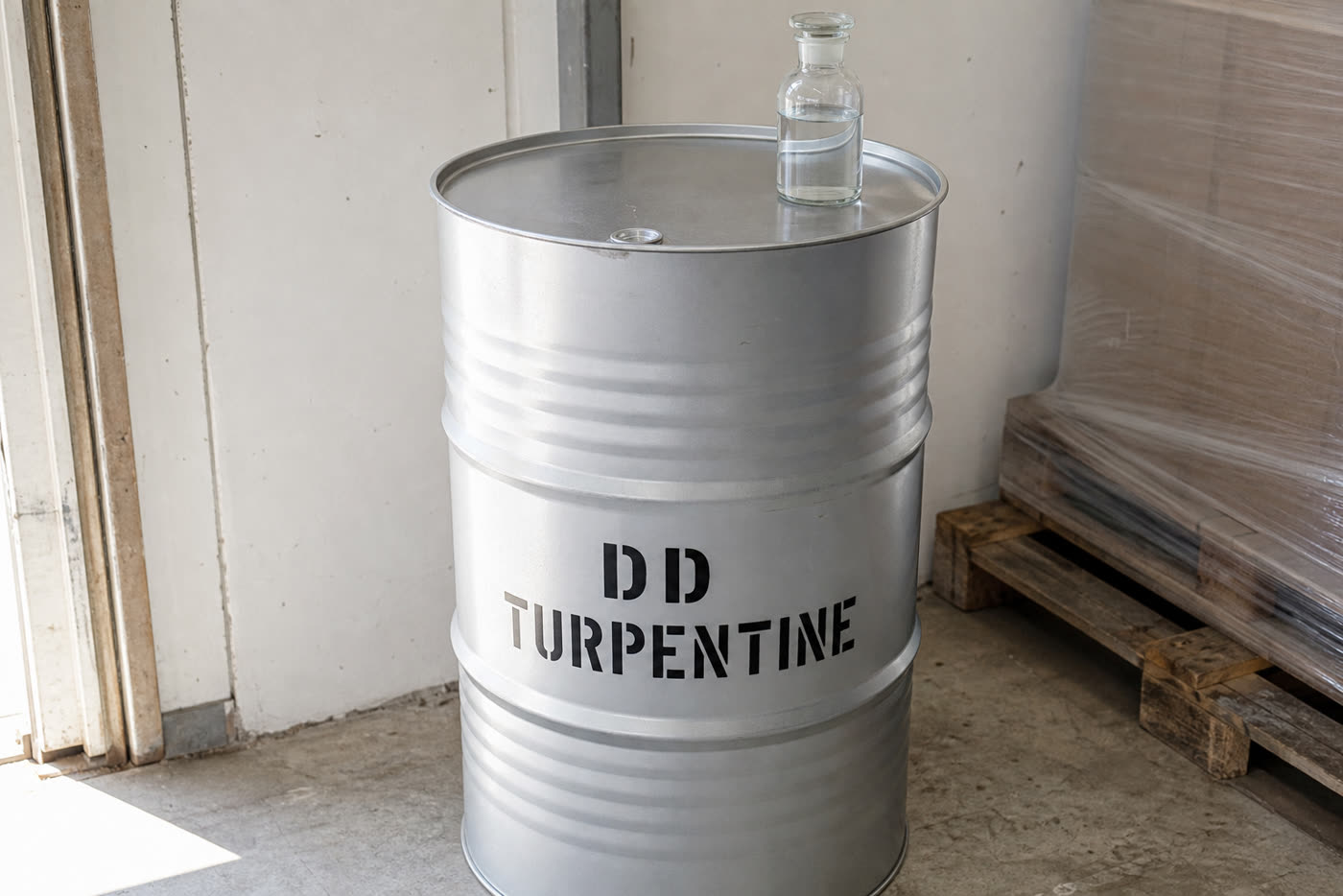
Double distilled turpentine oil is gum turpentine that has been run through a second, controlled distillation. The second pass raises alpha-pinene to 70 to 80 percent, removes heavy residues and water traces, tightens the boiling range and gives a paler, cleaner smelling oil. Buyers specify it wherever purity, low residue or consistent pinene content pays for itself.
What does the second distillation actually change?
Single distilled gum turpentine leaves the first still as a broad terpene cut. It contains the pinenes, but also heavier terpenes, traces of resinous matter carried over from the oleoresin, and moisture. A second fractionation under controlled temperature does four things:
- Concentrates alpha-pinene. Our standard gum turpentine oil runs 60 to 70 percent alpha-pinene by GC. The double distilled grade runs 70 to 80 percent.
- Cuts the heavy tail. High boilers and polymerised matter stay in the pot, so evaporation leaves less residue on a surface or in a reactor.
- Improves colour and odour. The oil comes over water white with a cleaner pine note, without the harsh back odour of crude cuts.
- Narrows the distillation range. More of the oil distils inside a tight band, which makes behaviour in downstream processes predictable batch after batch.
Nothing exotic happens chemically. Redistillation is a separation, not a reaction, which is exactly why buyers trust it. The molecules that arrive are the same pinenes, just more of them and less of everything else.
Who specifies double distilled turpentine, and why?
Pharma and personal care formulators
Liniments, balms, medicated rubs and veterinary preparations use turpentine as a counterirritant. Pharmacopoeia monographs for turpentine oil describe a rectified, redistilled material with tight limits on residue and distillation range, so buyers in this segment start from a redistilled grade as a matter of course. Low residue also matters for skin feel and formulation stability. See our post on turpentine oil pharma applications for the pharmacopoeia context.
Fragrance and aroma chemical producers
Anyone converting pinene into terpineol, camphor, pine oil or aroma intermediates buys pinene, not turpentine. A grade at 70 to 80 percent alpha-pinene delivers more usable feedstock per litre and less waste to strip out, which changes reactor economics directly. Buyers who need still higher purity step up to alpha-pinene 95%, but many conversion processes run comfortably on DD turpentine at a lower cost per unit of pinene.
Premium coatings and artist material makers
Artist colour houses sell turpentine as a thinning medium in small bottles, where any cloudiness, odour taint or greasy residue produces returns. DD grade evaporates from an oil paint film without leaving sticky high boilers behind. Wood finish and speciality varnish producers follow the same logic.
Laboratories and fine chemical users
Labs using turpentine as a reagent or reference solvent want a certificate of analysis they can reproduce. A narrow cut with a stated GC profile is far easier to qualify than a variable single distilled lot.
How do the two grades compare on paper?
| Parameter | Gum turpentine oil | Double distilled turpentine oil |
|---|---|---|
| Alpha-pinene (GC) | 60 to 70% | 70 to 80% |
| Specific gravity | 0.855 to 0.870 | 0.855 to 0.870, tighter within lot |
| Refractive index | 1.465 to 1.480 | 1.465 to 1.480 |
| Colour | Clear to pale | Water white |
| Evaporation residue | Low | Very low |
| Typical buyer | Solvents, general coatings, rubber, cleaning | Pharma, fragrance feedstock, artist colours, labs |
The physical constants overlap because both grades are still turpentine. The commercial difference lives in the GC trace and the residue test. For a fuller head to head, read gum turpentine vs double distilled.
When is DD grade worth the premium?
Run the arithmetic on pinene, not on litres. If your process consumes alpha-pinene, a drum at 75 percent pinene against a drum at 65 percent delivers roughly 15 percent more feedstock for a premium that is usually smaller than that. If your process consumes turpentine as a whole solvent and tolerates normal residue, standard gum turpentine is the economic choice.
Three questions settle it quickly:
- Does a residue or colour failure cost you rework or returns? Choose DD.
- Do you pay for pinene content downstream? Choose DD, or a pinene fraction.
- Is the oil a general purpose thinner or process solvent? Standard gum turpentine does the job.
Does DD turpentine replace pinene fractions?
Sometimes, and the arithmetic is worth running before every campaign. A converter producing terpineol or synthetic pine oil can feed either DD turpentine at 70 to 80 percent alpha-pinene or a distilled fraction at 95 percent. The fraction gives higher reaction selectivity and less downstream separation, but costs more per kilogram and adds a second supplier qualification. DD turpentine keeps one input, one COA and one drum stock, at the price of carrying 20 to 30 percent non pinene terpenes through the process. Plants with good fractionation downstream usually favour DD feed, plants without it favour the pure fraction.
There is also a middle path many buyers overlook: taking DD turpentine for the main reaction and buying small lots of specific terpenes, beta-pinene or carene, only for the products that need them. Because all of these cuts come off the same still train, a producer running the full ladder can supply the combination against one shipping schedule.
What handling does DD grade need?
The same as any turpentine: UN 1299, Class 3, packing group III, stored cool, sealed and away from ignition. The one extra discipline is oxidation control. A high pinene oil left in a part empty drum slowly loses assay and gains odour, so rotate stock first in, first out and keep bungs tight between draws.
How should buyers qualify a DD supplier?
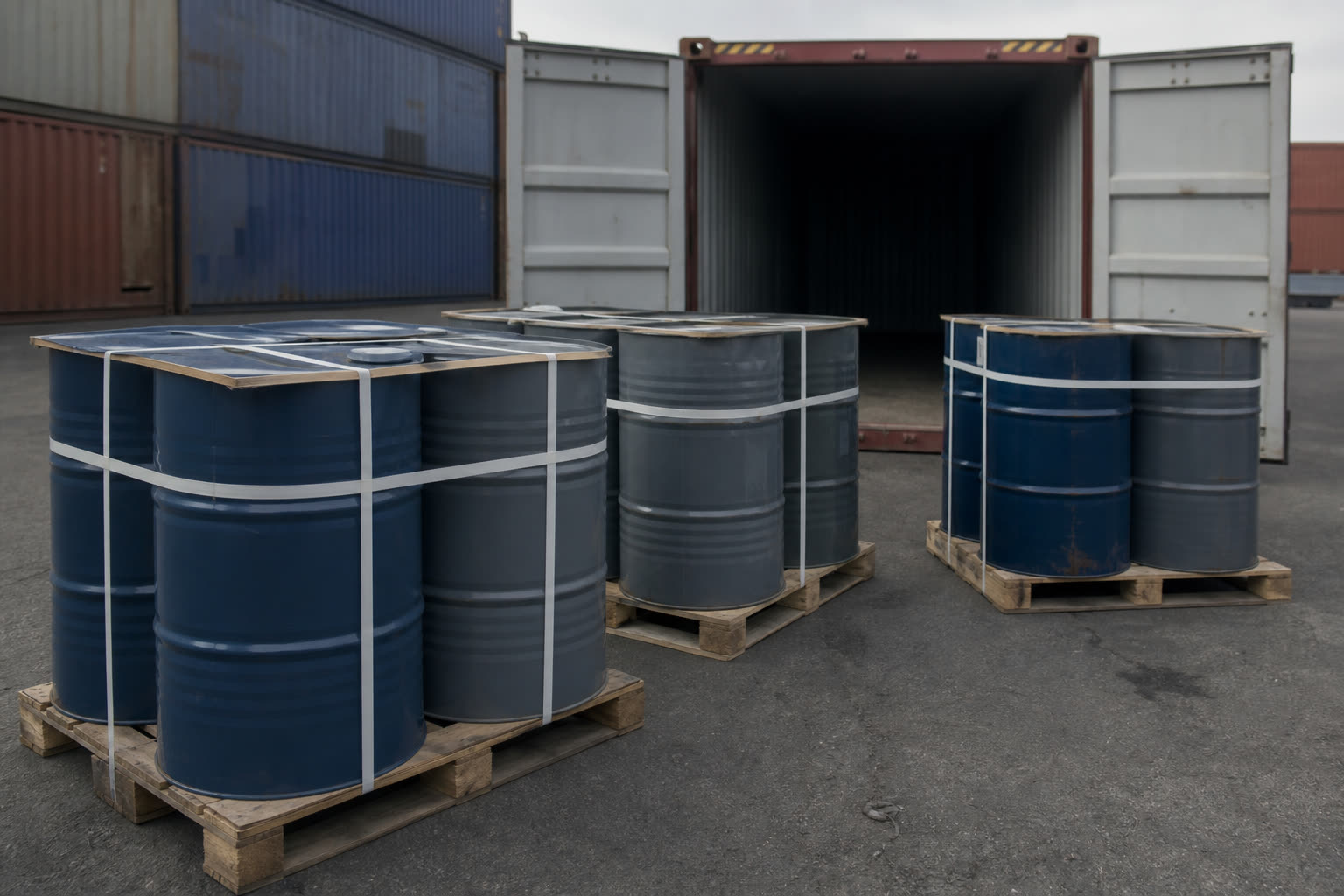
Ask for the GC chromatogram, not just a number on a datasheet. A genuine double distilled lot shows a dominant alpha-pinene peak, modest beta-pinene and carene peaks, and a clean baseline at the heavy end. Then confirm three commercial points: a COA issued with every consignment, a sample before any bulk order, and packing that suits your intake, whether that is 200 litre barrels or a dedicated tanker.
Shade & Shine Pine Chem has produced turpentine grades in Kanpur since 1980 and exports DD turpentine to the United States, Thailand, Indonesia and China in 200 litre barrels and 12,000 to 18,000 litre tankers. Request a pre shipment sample of double distilled turpentine, test it in your own process, then call +91 96965 09933 or email info@shadeshinepine.com for barrel or tanker pricing.