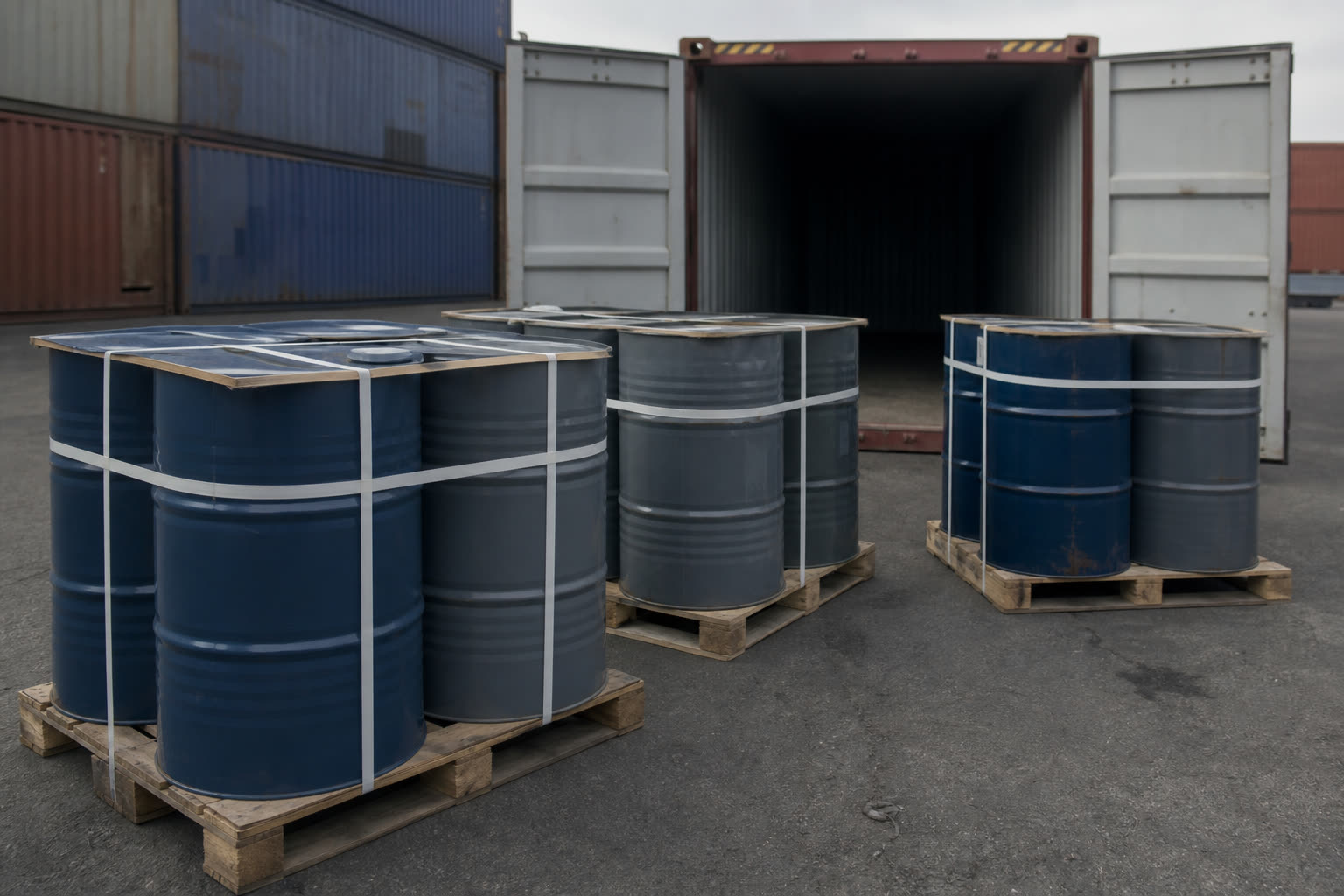
Sea freight for drummed liquid chemicals has a set of physical and regulatory norms that do not vary much between trade lanes. A 200-litre steel drum of turpentine going to the US follows essentially the same stuffing rules as one going to Thailand or Indonesia. What changes is the port, the shipping line, and occasionally the destination-country import documentation. This post covers the freight logistics side of things: how we pack containers, what the IMDG regulations require for flammable liquids, and what buyers should know before their first container arrives.
How many 200-litre drums fit in a standard container?
A standard 20-foot dry container (20-foot equivalent unit, or TEU) typically holds 80 drums of 200 litres when loaded loose (upright, directly on the container floor, two rows side by side). At a gross weight of roughly 190 to 195 kg per filled steel drum of turpentine, 80 drums comes to approximately 15,200 to 15,600 kg of cargo. Adding the container tare weight of around 2,200 to 2,300 kg, the total gross weight sits comfortably under the typical 28,000 kg maximum payload for a standard ISO container.
A 40-foot container can take around 160 to 162 drums on two levels if palletised. However, palletising drummed chemicals adds weight (the pallet itself), and stacking drums requires careful consideration of the drum top and bottom design, the product density, and the stowage plan. For heavy liquids like gum turpentine oil or double-distilled turpentine oil, we more commonly ship 20-foot containers at 80 drums rather than stacked 40-foot containers, because it is simpler and the risk of drum damage from stacking is eliminated.
Palletised versus loose loading: which is better?
Loose loading (drums standing directly on the container floor) works well when the container will not be transshipped multiple times and the voyage is not particularly rough. The drums must be blocked and braced or lashed with cargo straps so they cannot roll or tip. Per the IMO/ILO/UNECE CTU Code (the Code of Practice for Packing of Cargo Transport Units), all cargo in a container must be secured against shifting in all directions throughout the voyage. For a 20-foot container of 80 drums, we typically use timber dunnage and lashing straps across alternate rows.
Palletised loading is better when the cargo is being handled with forklifts at multiple points and when the transshipment risk is higher. The pallet protects the drum bottom from point loads and makes port handling faster. The downside is added weight and slightly fewer drums per container. For buyers ordering regularly, the choice of loose or palletised loading is usually agreed in the initial commercial discussion. We accommodate either.
What is UN 1299, and why does it matter?
UN 1299 is the United Nations dangerous goods number for turpentine. Under the IMDG Code (International Maritime Dangerous Goods Code), which governs the transport of hazardous cargo by sea, turpentine is classified as: Class 3 (flammable liquid), Packing Group III (relatively low hazard within the flammable liquids class), and is also identified as a marine pollutant in the IMDG index. This means that every sea shipment of turpentine, whether it is standard gum turpentine oil or our redistilled grades, must be declared as dangerous goods to the carrier.
The IMDG proper shipping name on the document must read: UN 1299, TURPENTINE, Class 3, Packing Group III, with the marine pollutant designation noted if confirmed for the specific product by the SDS. Shipping lines require this declaration at booking, not at the port gate. Missing or incorrect dangerous goods declarations will cause the booking to be rejected or, worse, the container to be offloaded after loading when the terminal discovers the discrepancy. Either scenario is expensive and delays delivery by days or weeks.
What does IMDG compliance require in practice?
Beyond the dangerous goods declaration (which must be prepared and signed by a trained, authorised person), IMDG compliance for a turpentine shipment requires the following:
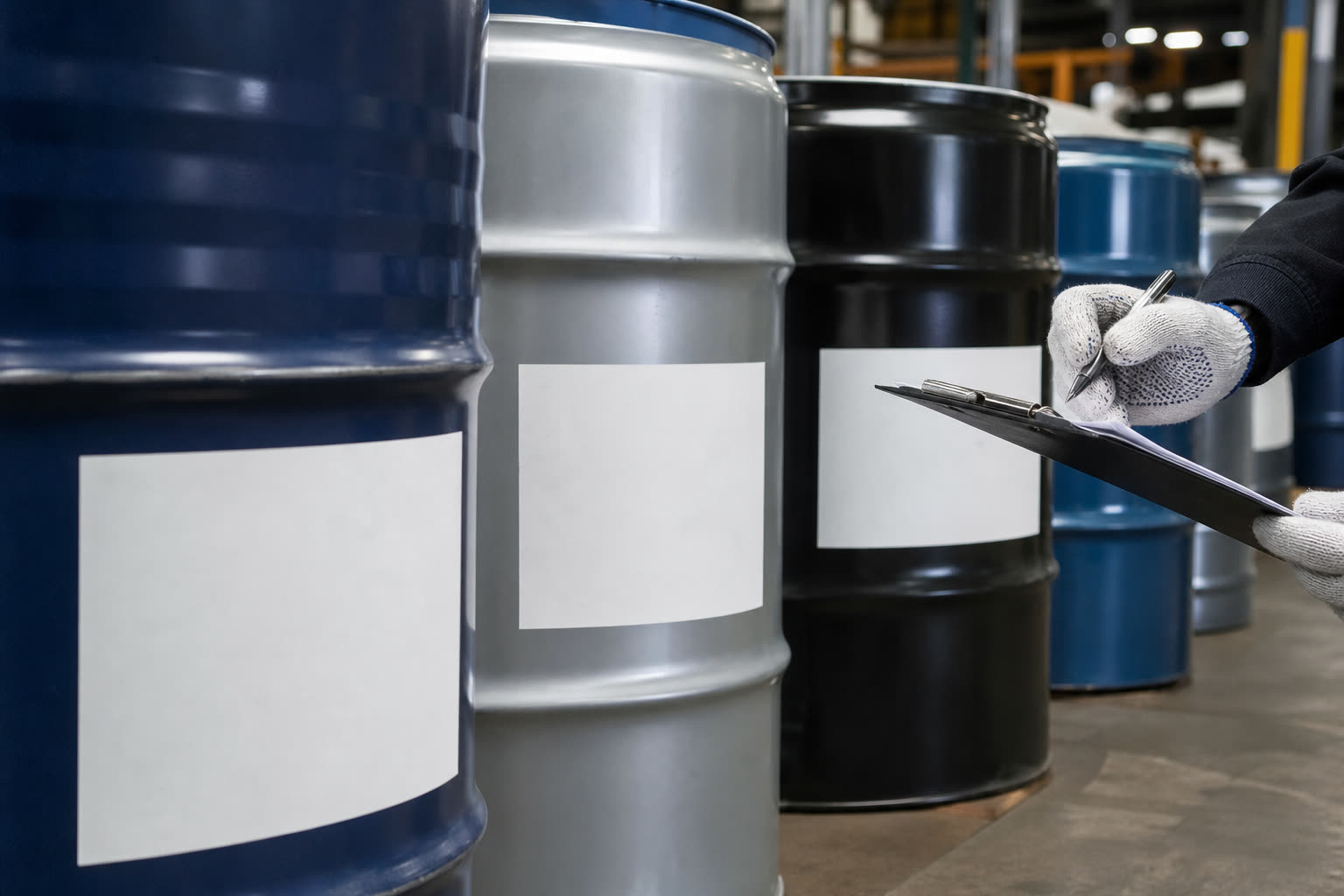
- UN-approved drums: each 200-litre steel drum must be a UN-specification package, tested and certified for Class 3 liquids. The UN marking on the drum (e.g., 1A1/Y1.8/250/...) confirms this. We use UN-certified drums as standard. Do not assume any steel drum is automatically UN-approved.
- Correct marking and labelling: each drum must carry the UN number (UN 1299), the proper shipping name, the Class 3 diamond label (red, with flame symbol), and the marine pollutant mark (if applicable) on the drum itself, not just on the outer packaging.
- Container packing certificate: the person or company stuffing the container must sign a container/vehicle packing certificate confirming that the goods were loaded in accordance with IMDG rules.
- Stowage category A: IMDG assigns turpentine stowage category A, which permits both on-deck and under-deck carriage. The carrier's dangerous goods plan determines actual placement.
- Emergency schedule: EmS F-E (fire) and S-E (spillage) apply. These codes tell ship crews what to do in an emergency; they appear on the dangerous goods manifest.
What about pine oil: is it also classified dangerous?
Pine oil is also classified as a flammable liquid under IMDG (UN 1272, pine oil, Class 3, Packing Group III), so it travels under the same general framework as turpentine. Rosin and rosin-based solid products like ester gum, shipped in 25 kg woven bags, are not classified as IMDG dangerous goods and ship as general cargo. The documentation and container requirements for solids are much simpler.
What should buyers ask before booking a shipment?
If you are new to importing drummed chemicals, ask your freight forwarder these questions before the first booking: Is the forwarder trained and authorised to prepare IMDG dangerous goods declarations? Does the proposed shipping line accept Class 3 liquids on that trade lane (not all lines accept hazardous cargo on all routes)? What is the cut-off for dangerous goods documentation submission relative to vessel departure? Typically, DG docs must be submitted 24 to 48 hours before vessel cut-off.
These are not trick questions. They are standard operational matters, and any experienced chemical freight forwarder will answer them without hesitation. If they cannot, find one who can.
We have been packing and shipping pine chemicals since 1980 and work with freight forwarders who know these requirements thoroughly. If you would like to discuss logistics arrangements for your next order, reach out to info@shadeshinepine.com or call Yash Agarwal on +91 96965 09933.