We have been in the solvent supply trade since the 1970s and we have seen what happens when a buyer accepts Mineral Turpentine Oil without proper quality verification. Paint films stay tacky for days. Brushes do not clean properly. In worst cases, a batch of adulterated MTO invalidates a coating job and brings a dispute that costs far more than the original saving on the solvent price. This post explains what to check, what numbers to expect, and how to recognise the most common form of adulteration in the Indian market.
What Does a Complete MTO Certificate of Analysis Cover?
The relevant Indian standard for petroleum hydrocarbon solvents is IS 1745:2018. A proper COA for MTO should report at minimum the following parameters:
- Appearance: clear liquid, free from sediment, suspended matter, and undissolved water
- Density at 15 degrees Celsius, typically around 0.77 to 0.80 g/mL depending on grade
- Flash point by Abel closed cup: minimum 35 degrees Celsius for standard MTO grades
- Distillation profile: initial boiling point, temperature at 50 percent and 90 percent recovery, and final boiling point; for IS 1745 grade 145/205, IBP is at least 145 degrees Celsius and FBP does not exceed 205 degrees Celsius
- Aromatic content as a percentage by volume
- Residue on evaporation: should be very low, typically under 0.005 percent by mass, indicating that the solvent leaves no meaningful film after evaporation
- Copper strip corrosion at 50 degrees Celsius for three hours: should pass, indicating absence of corrosive sulfur compounds
- Colour by Saybolt scale
A COA that gives only flash point and density is not adequate for a commercial acceptance decision. Insist on the full parameter list, and confirm that testing was performed by a recognised petroleum laboratory on the batch in question, not on a reference sample of indefinite age.
Why Is the Distillation Profile the Key Test?
The distillation profile is the most informative single check on MTO quality. It tells you the boiling range of the product, which directly governs evaporation rate and solvency behaviour in use. An MTO with the correct IBP-to-FBP range will thin your paint to the expected viscosity and evaporate within the expected time window. One that deviates in either direction will behave differently on the brush and on the surface.
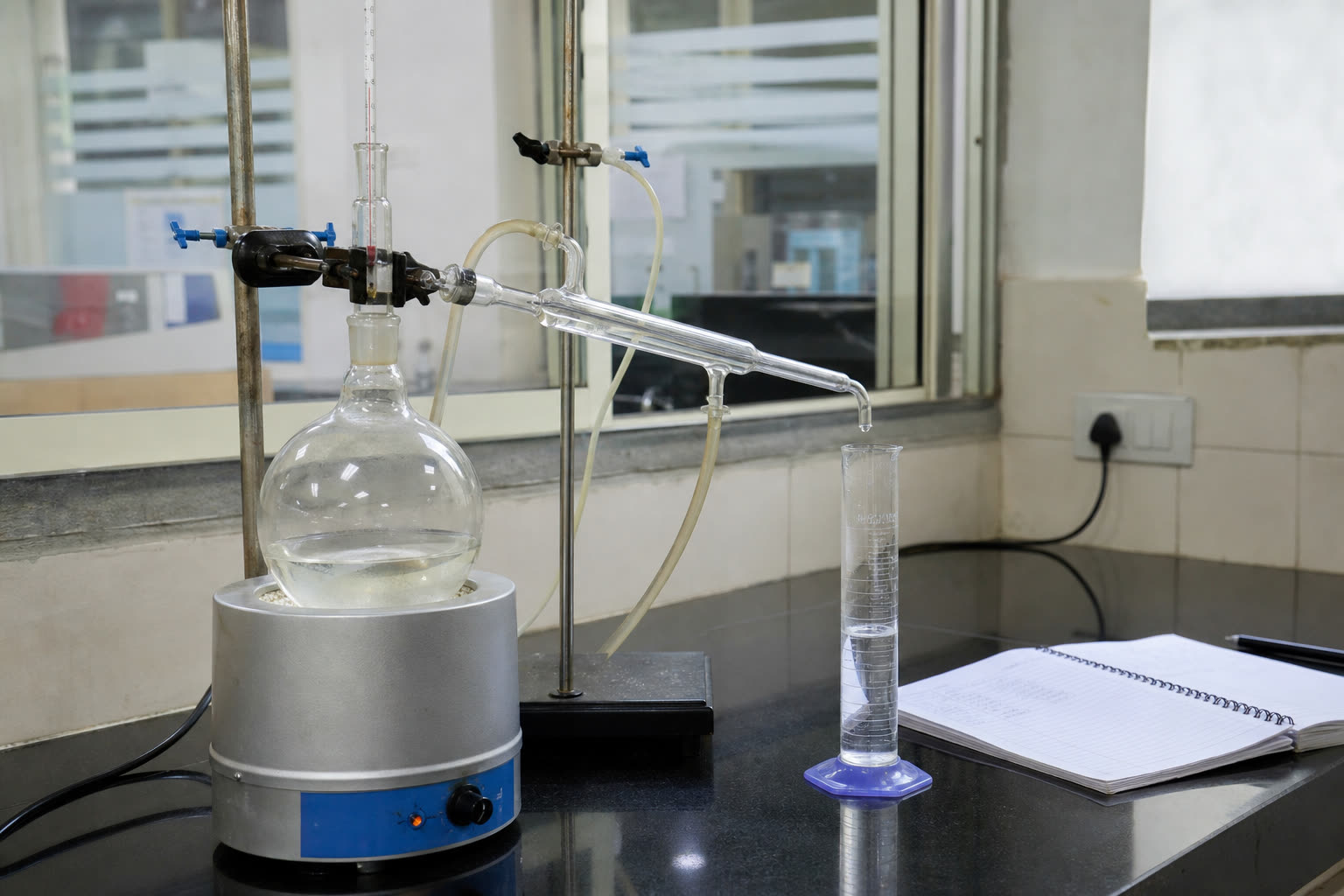
Distillation is run under IS 1448 Part 18, which is based on ASTM D86. The method records temperature at defined volume recovery points, and the resulting curve shows whether the product is too light, too heavy, or has an unusual spread. For standard grade MTO, you expect a fairly tight curve between roughly 145 and 205 degrees Celsius with a smooth recovery progression. If the curve starts earlier than the declared IBP, the product may contain lighter fractions. If the FBP extends significantly beyond the declared limit, heavier components are present.
How Does Kerosene Get Into MTO, and Why Does It Matter?
Kerosene is heavier than standard MTO, with a higher boiling range and typically a lower flash point than the minimum for MTO. Blending kerosene into MTO reduces the unit cost of the batch from the seller's perspective while increasing the apparent volume. In markets where buyers do not test incoming material, this practice can be profitable for unscrupulous suppliers.
The consequences for the buyer are real. Kerosene in MTO shifts the distillation curve downward, which can delay drying of oil-based paints and leave a residual odour. If the kerosene brings the flash point below the Class B threshold of 23 degrees Celsius, the material becomes Class A petroleum, with stricter storage and transport requirements that the buyer may not be set up to meet. And if the adulteration is significant, the residue on evaporation may increase, leaving a trace film that affects finish quality.
How Do You Detect Kerosene Adulteration?
The primary reliable method is gas chromatography comparing the suspect sample's hydrocarbon fingerprint against a reference MTO and a reference kerosene. GC shows the characteristic peaks of each product and can identify and estimate the proportion of kerosene in a blended sample with good accuracy. This test requires a laboratory equipped for petroleum GC and is the method of choice when the financial stakes are significant.
For a quick on-site screen, density measurement can give a first indication. Kerosene typically has a higher density than MTO, so a blend will show a density above the expected MTO range. However, density alone is not conclusive: blending proportions can be calibrated to remain within the MTO density band, so a passing density result does not rule out adulteration.
A distillation test is the most practical intermediate-tier check. Kerosene pushes the FBP upward and can also lower the IBP if lighter kerosene cuts are used. If your distillation curve does not match the supplier's declared profile, reject the batch and request GC confirmation before making any further purchases from that source.
A sulfuric acid qualitative test has been described in some forensic literature for detecting kerosene in turpentine oil, producing a colour change in positive cases. We mention it for completeness, but this test involves concentrated acid and is hazardous to perform without proper equipment. Treat any positive result from such a screen as presumptive and confirm with GC.
Practical Acceptance Procedure
Before accepting a delivery, draw a composite sample from multiple points in the drum or tanker, seal it, label it with batch number and date, and retain one sealed reference portion. Run or commission at minimum a flash point check, a visual clarity check, and a density check at the point of receipt. For first shipments from a new supplier and for any shipment where the price was unusually low, add a full distillation test.
Reject or quarantine any lot that fails a specification limit, shows water or sediment, or produces a distillation curve inconsistent with the declared grade. Document the rejection clearly with the sample evidence retained. This procedure costs a modest amount per shipment and can save a substantial sum per adulterated delivery avoided. See our blog post on how to read a certificate of analysis for help interpreting what comes back from the laboratory.
Shade Shine Pine Industries supplies MTO sourced from recognised Indian refineries, with COA documentation available for each batch. We supply in 1-litre Shade Shine branded bottles in cartons for retail buyers, in 200-litre drums, and by road tanker for bulk requirements. Enquiries to Yash Agarwal at info@shadeshinepine.com or +91 96965 09933.