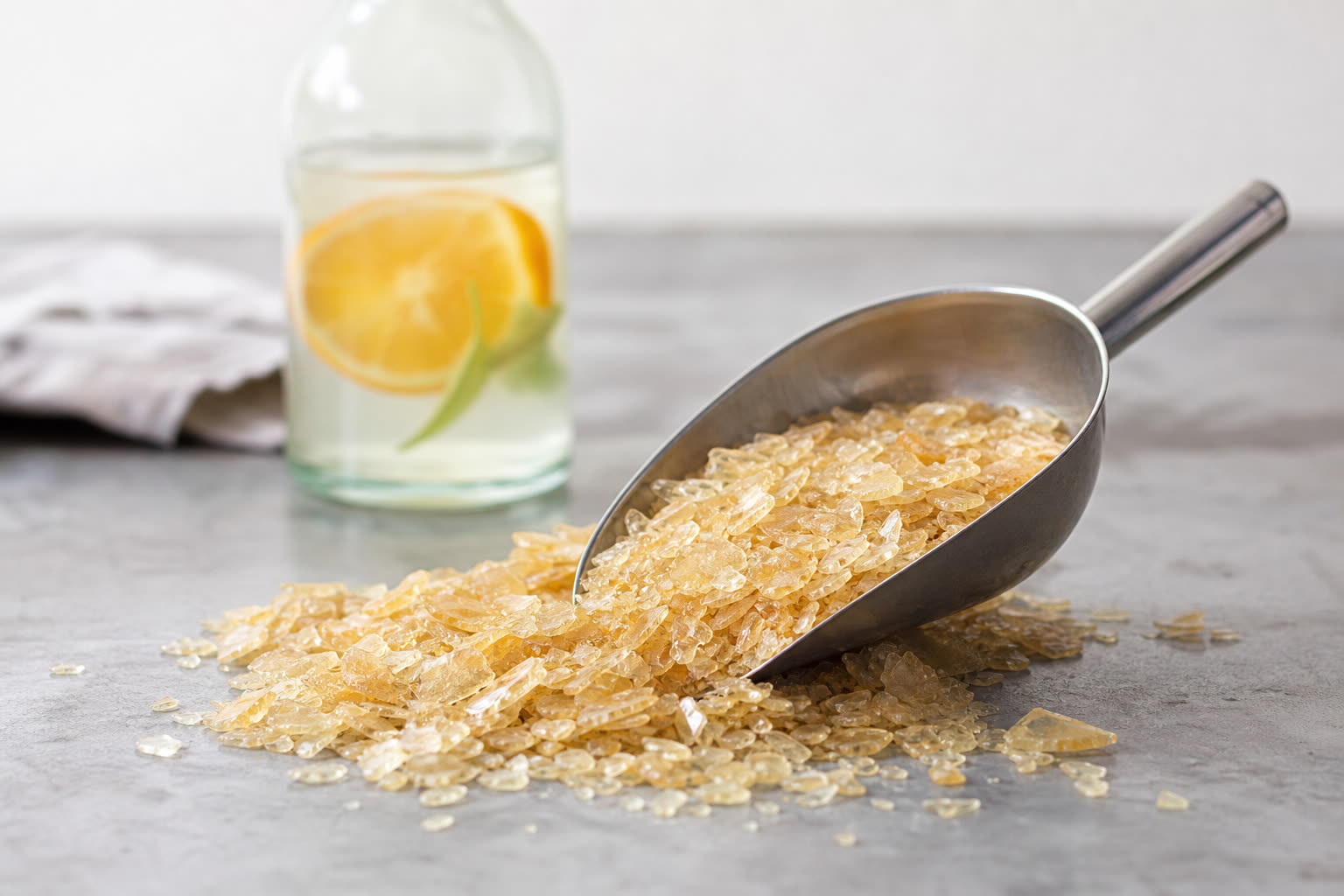
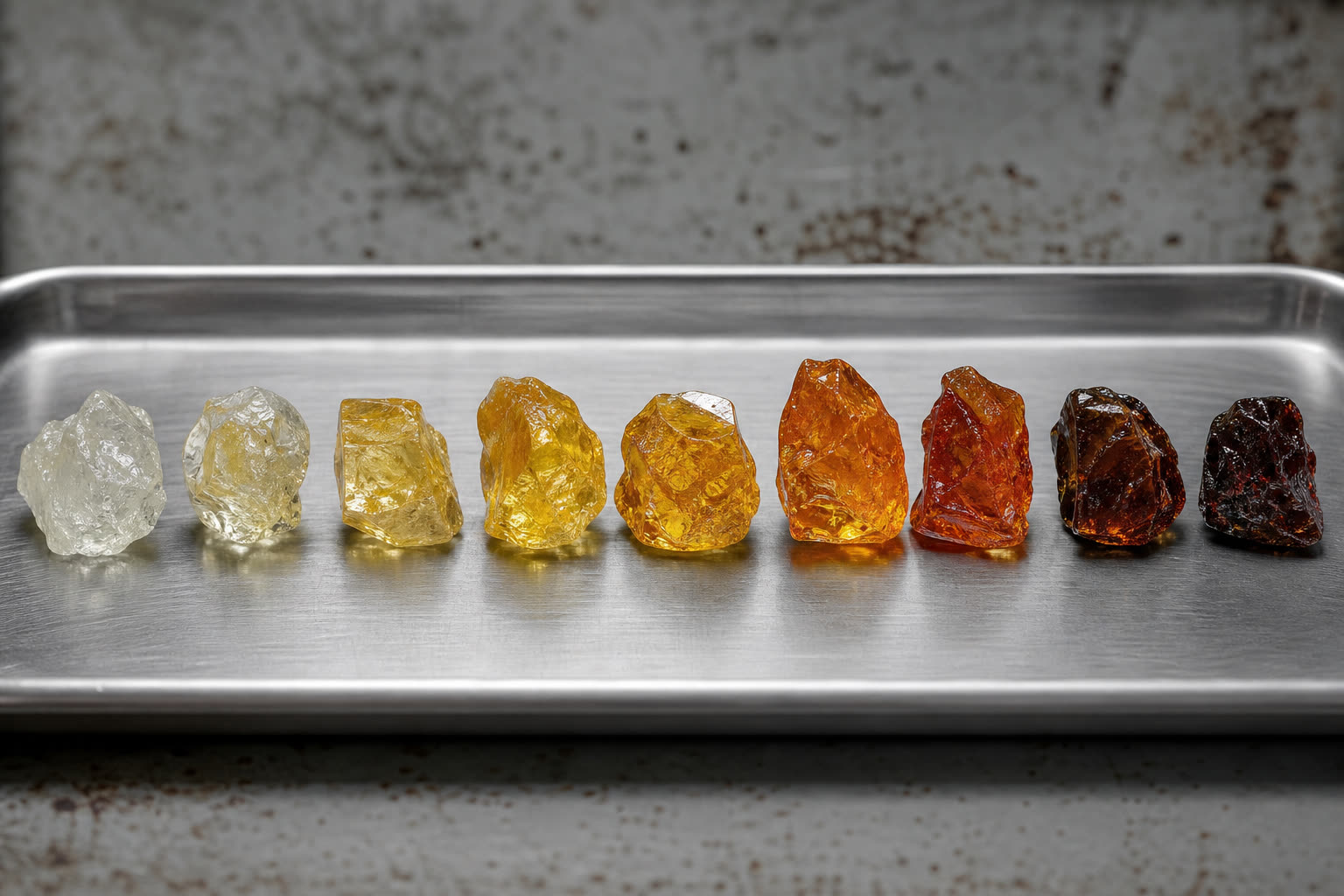
Gum rosin is the solid resin recovered when crude pine oleoresin is distilled to remove turpentine. What remains is a brittle, amber-coloured solid made up mainly of abietic acid and related resin acids. The colour of the finished product depends on the source pine, the tapping season, the condition of the oleoresin on arrival, and the care taken during distillation. To bring order to this natural variation, the industry adopted a letter-based colour grading system that runs from the palest to the darkest. Those grades are, in order from lightest to heaviest: WW, WG, X, N, M (sometimes listed as White or Yellow Colophony), K, I, H, and G. Not every supplier stocks every grade. At Shade Shine Pine Industries we regularly supply nine grades: K, D, B, N, X, WG, WW, White Colophony, and Yellow Colophony.
How the Grading System Works
Grading is done visually by comparing a molten sample against standard glass colour comparators, or by the Gardner colour scale in some markets. The further along the alphabet you go, the darker and more processed the material. A WW (Water White) grade is very pale, almost translucent. A K grade is dark amber, closer to what many people picture when they think of rosin. Both are fully functional rosins; the grade choice depends entirely on what your process or end-product demands.
WW and WG: The Pale Grades
WW (Water White) and WG (Window Glass) are the lightest commercially available grades. They are produced from fresh, clean oleoresin with careful temperature control during distillation. These grades go into:
- Adhesives and hot-melt formulations where colour bleed into a substrate would be visible
- Paper sizing agents, where a pale rosin soap gives a cleaner appearance to finished paper
- Food-contact applications such as chewing gum base and citrus beverage clouding agents, where pale colour and low impurity levels are required
- Some cosmetic and pharmaceutical applications where a light product is specified
Buyers choosing gum rosin for food-grade or cosmetic use should always confirm the acid value and softening point alongside the colour grade, because colour alone does not define purity.
X and N: The Mid-Range Workhorses
X and N grades are the most widely traded grades globally. They strike the balance between acceptable colour and cost. Typical applications include:
- Soldering flux, where the rosin acts as a mild acid activator to clean oxide layers from metal surfaces
- Rubber and tyre compounding, where rosin acids function as dispersing agents and plasticisers
- Printing inks, where the rosin is esterified or maleated before use
- General-purpose adhesives where exact colour is not critical
K and Darker Grades: High-Volume Industrial Use
K grade and darker are the backbone of high-volume industrial use. They cost less than pale grades and perform perfectly well in applications that are colour-tolerant:
- Size-press and wet-end paper sizing in commodity paper mills
- Tall oil derivatives blending, where rosin is one component among others
- Road-marking compounds and some construction sealants
- Basic soap making and emulsifiers where colour in the final product is masked
Yellow Colophony and White Colophony
Yellow Colophony and White Colophony are designations used in some Asian and European trade specifications rather than a separate grading letter. White Colophony corresponds broadly to the WW-WG range; Yellow Colophony sits in the N-X range. If your specification calls for these terms, ask your supplier for the corresponding Gardner colour number so you can compare across sourcing regions without ambiguity.
What to Check Beyond Colour Grade
Colour is not the only quality parameter. A well-written purchase specification for rosin should also include:
| Parameter | Typical Range | Why It Matters |
|---|---|---|
| Softening Point (Ring and Ball) | 72-78 deg C | Affects melt viscosity in hot-melt adhesives and ester reactions |
| Acid Value | 160-175 mg KOH/g | Indicates resin acid content; critical for esterification yield |
| Unsaponifiable matter | Less than 6% | Higher levels can interfere with sizing and adhesive performance |
| Moisture | Less than 0.5% | Excess moisture causes foaming in ester reactors |
Choosing the Right Grade
A simple rule: if your downstream product is visible and light-coloured, buy the palest grade your budget allows. If colour is masked by pigments, fillers, or opaque substrates, buy the grade that meets your acid value and softening point targets at the best price. For esterified derivatives such as glycerol ester of gum rosin or ester gum, the rosin grade you start with directly affects the colour of the finished ester, so pale input means pale output.
Shade Shine Pine Industries has worked in pine chemistry from Kanpur since 1980 and exports gum rosin in all nine grades worldwide. If you are evaluating grades for a new formulation or switching suppliers, we can provide samples on request. Bulk orders ship in 25 kg bags or 200 litre net-equivalent packs. Call us on +91 96965 09933 or write to info@shadeshinepine.com to discuss your grade requirements and request a sample lot.